


What is the main cause of death for climbers?
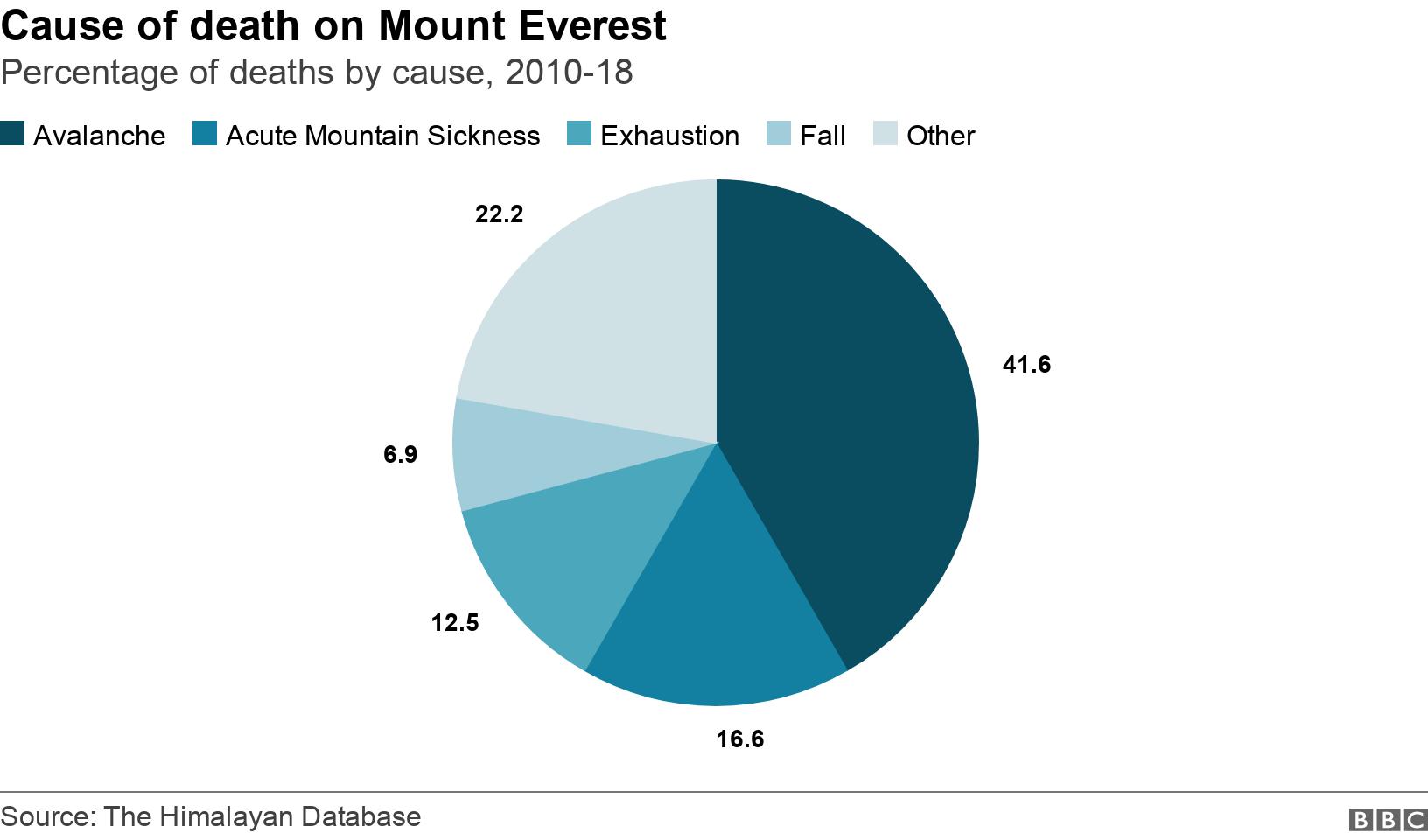
What kills most climbers on Everest
Of all deaths from 1950 to 2019 in non-Sherpa climbers during a summit bid on Mount Everest, about 35% were caused by falls, with other leading causes being exhaustion (22%), altitude illness (18%) and exposure (13%). In Sherpa deaths over the same time period, 44% were attributable to avalanches.
Cached
Do most climbers die on the way down
Researchers have found that they most often die during the descent, after being ravaged by low pressure, oxygen scarcity and severe cold in what is called the death zone, above 26,000 feet. Victims commonly show symptoms of high-altitude cerebral edema, a fatal swelling in the brain.
What is the most common cause of death for high altitude climbers
Well, when you're climbing above 8,000 meters, a lot can go wrong. Acute mountain sickness and exhaustion are believed to be the leading causes of death on the mountain.
Cached
Why do climbers die on the descent
Elevation levels above 8,000 m or 26,247 ft is often referred to as the death zone. At these levels, the air is so thin that even with oxygen tanks, the climate is just so inhospitable that your body starts to break down and you can only remain at these elevations for a short period of time.
Why are bodies left on Everest
However, the reasons for leaving the bodies behind are purely logical. The dangers of Everest make retrieving a body extremely difficult – sometimes impossible – and expensive. Bodies resting above Camp 2 21,000ft cannot be retrieved by helicopter. Instead, the bodies need to be carried down the mountain for retrieval.
Is Sleeping Beauty still on Everest
Francys Arsentiev is known as The Sleeping beauty of Everest. She died on Mount Everest on May 24, 1998, when she descended from the top of the tallest mountain after setting the record of the first American female to climb Everest without oxygen. Francys was an American native, born and raised in Hawaii, Honolulu.
Is it harder going up or down Mount Everest
As difficult as it is to scale Mount Everest, coming back down from the world's tallest peak is far more deadly, a new study shows.
How long can you stay in the death zone on Everest
16 to 20 hours
People are advised not to stay in the death zone for more than 16 to 20 hours. Here are a few things to know about the Everest Death Zone: More than 200 climbers have died on Mount Everest since Tenzing Norgay and Edmund Hillary's first official ascent in 1953. Most of them lost their lives in the death zone.
What happens to your body on Everest death zone
In the death zone, climbers' brains and lungs are starved for oxygen, their risk of heart attack and stroke is increased, and their judgment quickly becomes impaired. "Your body is breaking down and essentially dying," Shaunna Burke, a climber who summited Everest in 2005, told Business Insider.
At what elevation does the death zone begin
8,000 metres
The summits of the world's 14 tallest mountains are all found in what is ominously known as the “death zone,” which is typically identified as 8,000 metres (26,000 feet) above sea level. At these altitudes, the oxygen levels are insufficient to sustain human life for an extended period.
How many bodies are currently on Mount Everest
To date, it's estimated that some 300 people have died climbing Earth's tallest mountain and that there are approximately 200 dead bodies on Mount Everest to this day. These are the stories behind just some of the bodies on Mount Everest that have accumulated over the years.
Do they ever remove bodies from Everest
Because of the cost and extreme risk to the retrieval team, few bodies ever leave Everest. And many mountaineers prefer their bodies stay on the mountain if they pass there in the tradition taken from sailors lost at sea.
Are there bodies not found on Everest
There are thought to be over 200 bodies left on Mount Everest. No one is entirely sure how many or exactly where many are because of the horrific and unrelenting conditions. That means two-thirds of the people that died on Everest are still there. Why Do People Climb Everest
How long can you stay on top of Mount Everest
People are advised not to stay in the death zone for more than 16 to 20 hours. Here are a few things to know about the Everest Death Zone: More than 200 climbers have died on Mount Everest since Tenzing Norgay and Edmund Hillary's first official ascent in 1953. Most of them lost their lives in the death zone.
How cold is on top of Everest
The weather and climate of Mount Everest is one of extremes. Temperatures at the summit are never above freezing and during January temperatures can drop as low as -60° C (-76° F). Despite the low temperatures the biggest issue faced by climbers are hurricane force winds and wind chill.
What happens to human body in Everest death zone
In the death zone, climbers' brains and lungs are starved for oxygen, their risk of heart attack and stroke is increased, and their judgment quickly becomes impaired. "Your body is breaking down and essentially dying," Shaunna Burke, a climber who summited Everest in 2005, told Insider in 2022.
Can you bring bodies down from Everest
To retrieve a body takes a team of rescuers or Sherpa capable of digging out frozen bodies and bearing the extra weight of a frozen corpse down the mountain. The cost of such an expedition can climb above $70,000. Because of the cost and extreme risk to the retrieval team, few bodies ever leave Everest.
Why are dead bodies not removed from Everest
However, the reasons for leaving the bodies behind are purely logical. The dangers of Everest make retrieving a body extremely difficult – sometimes impossible – and expensive. Bodies resting above Camp 2 21,000ft cannot be retrieved by helicopter. Instead, the bodies need to be carried down the mountain for retrieval.
What altitude kills brain cells
Losing brain cells due to high altitude exposure. Everest is an extreme example. Yet, the brain damage these climbers get from 23,000-feet in Argentina sounds terrifying…
How many corpses are on Mount Everest
200
The mountain has claimed over 300 climbers in recent history, and about two-thirds of that number remain on the mountain. The current estimate of remains left behind on Everest total around 200.
Why are bodies not removed from Everest
An curved arrow pointing right. More than 310 people have died climbing Everest since exploration first started in the early 1900s. It's dangerous to retrieve the bodies, so many litter the mountain to this day.
What was the deadliest day on Everest
On May 10, 1996, 12 climbers who had scaled the mountain were caught in a blizzard as they began their descent from the peak.
Why can’t bodies be brought down on Everest
However, the reasons for leaving the bodies behind are purely logical. The dangers of Everest make retrieving a body extremely difficult – sometimes impossible – and expensive. Bodies resting above Camp 2 21,000ft cannot be retrieved by helicopter. Instead, the bodies need to be carried down the mountain for retrieval.
What is the safest time of year to climb Everest
The most popular months for trekking in the Everest region are March, April, May, October and November, as these months are when the conditions are at their best. The spring and the autumn tend to offer reasonable temperatures, clear skies, little-to-no rain, and less chance of problematic snowfall.
Has anyone spent the night on Everest summit
Chiri eventually found work portering for Everest expeditions, and eventually reached the summit of Everest ten times. In May 1999, he spent a record 21 hours on the summit without supplementary oxygen, and without sleeping. He also went on some expeditions to Cho Oyu.